Beyond the Hardware Advantage: Why Japan’s Physical AI Future Depends on Software
Japan’s industrial robotics infrastructure is, by almost any measure, the most sophisticated in the world. Fanuc, Yaskawa, Kawasaki, Denso, and a network of precision component suppliers have spent decades compounding a manufacturing advantage that no country has been able to replicate at scale. According to the IFR World Robotics 2025 report, Japan ranks fourth globally in robot density at 446 units per 10,000 manufacturing employees — behind Korea, Singapore, and Germany, and growing at 5% annually since 2019. Its hardware supply chain is structurally embedded in global automotive, semiconductor, and consumer electronics production.
But the defining competition in robotics has shifted. The companies gaining ground in Physical AI, the discipline that makes robots perceive, reason, adapt, and operate autonomously in unstructured environments, are not winning on actuator torque or mechanical repeatability. They are winning in software. On the orchestration layer that coordinates robot fleets in real time. On the digital twin infrastructure that compresses test cycles from weeks to hours. On the MLOps pipelines that push updated perception models to embedded hardware at the edge, increasingly with minimal manual intervention as the deployment matures. On the simulation environments that generate the training data that makes autonomous behavior possible in the first place.
The hardware is necessary but no longer sufficient. For engineering leaders at Japanese industrial and technology companies, this shift is not a future consideration. It is the current competitive constraint, and understanding where the software layer actually lives, and what it takes to build it, is the starting point for any serious Physical AI strategy.
Japan Still Leads in Hardware, But the Game Has Changed
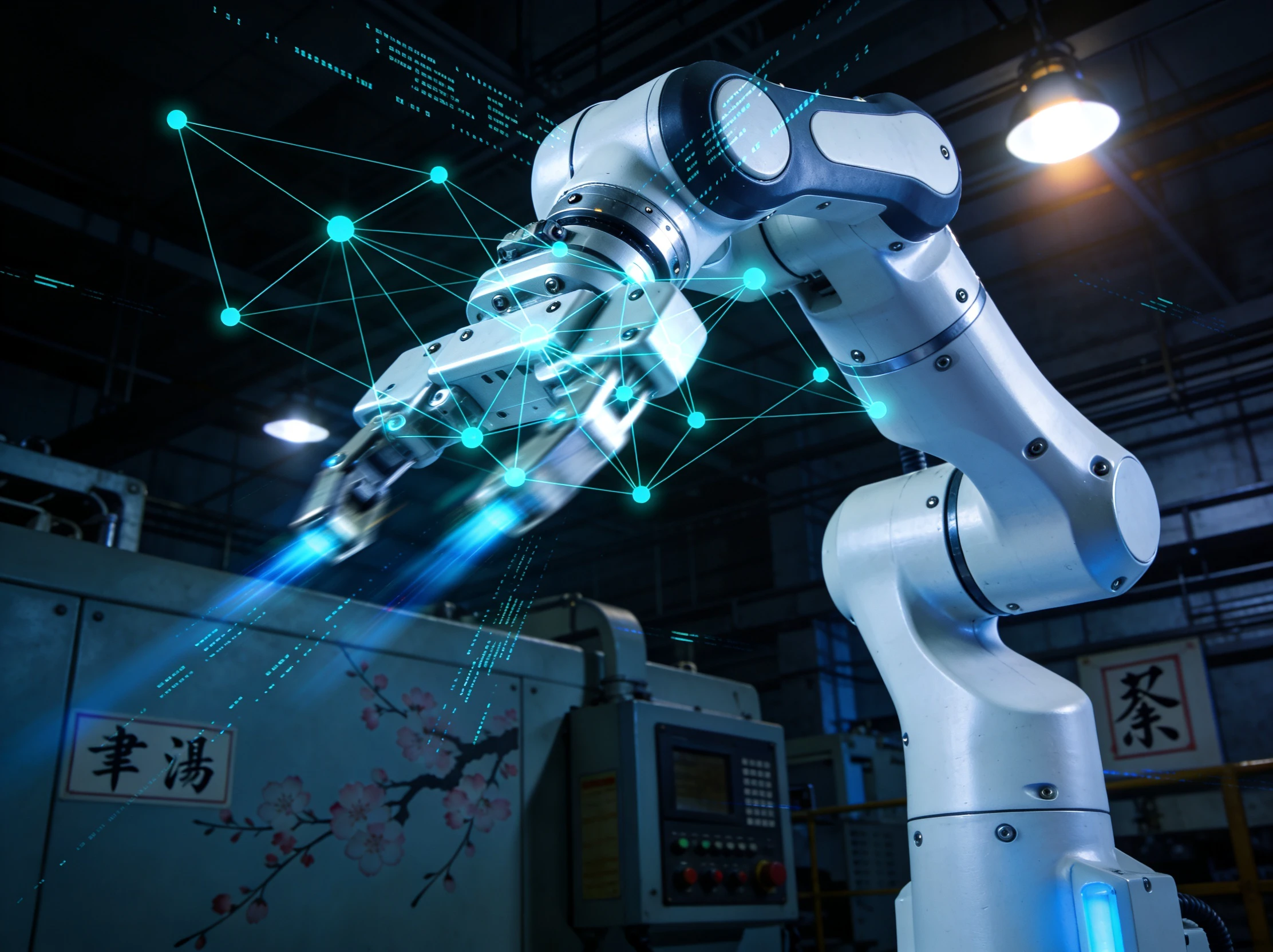
The evidence for Japan’s hardware position is not in dispute. Japan remains one of the global leaders in industrial robotics production, and its precision engineering tradition runs deep into material science, motion control, and mechanical reliability. When a manufacturing operation needs a robot arm that performs the same weld to micrometer tolerance for a decade, Japanese components are often part of the answer.
The gap shows up most clearly when the environment changes. A conventional industrial robot is a fixed-program machine: it executes a defined motion sequence in a controlled environment. Introduce a new part geometry, an obstacle, or a variance in material properties — and the robot stops, faults, or produces a reject. Reprogramming requires specialist time. Retraining motion requires a physical setup. The flexibility that Physical AI promises — robots that handle variability the way a skilled human worker does — requires software, not mechanics.
The shift became visible when companies like Boston Dynamics, Figure, Physical Intelligence, and Skild AI began demonstrating robots that generalize across tasks using foundation-model architectures. Skild AI, which launched its unified robotics foundation model in 2024, grew from zero to roughly $30 million in annual revenue in a matter of months before closing a $1.4 billion round in January 2026. Then, it tripled its valuation to $14 billion in seven months, with SoftBank leading and Nvidia’s venture arm participating. The commercial signal is unambiguous: software-defined robot intelligence is attracting capital and delivering revenue at a pace that hardware cycles cannot match.
On the infrastructure side, NVIDIA’s Omniverse Isaac Sim established physics-accurate simulation as a first-class engineering concern for Physical AI teams. At GTC 2025, NVIDIA then released Isaac GR00T N1 — the world’s first open, fully customizable foundation model for humanoid reasoning, and demonstrated that its synthetic data pipeline could generate 780,000 training trajectories in under 11 hours, improving model performance by 40% compared to real data alone. ROS 2 matured from an academic framework into the de facto middleware for robotics software teams across autonomous vehicles, logistics, and industrial automation.
Japanese companies and investors saw this transition clearly and have begun moving capital accordingly. SoftBank’s decision to lead Skild AI’s $1.4 billion round is the most visible signal, but it is not isolated: Japanese industrial conglomerates, including Kawasaki Heavy Industries and Fanuc, have expanded their robotics software divisions, and METI’s AI and robot strategy frameworks increasingly treat software capability as a national competitiveness priority alongside hardware.
Capital commitment and strategic intent, however, are not the same as engineering capacity. Knowing where the competitive frontier has moved is not the same as being able to staff the teams that build toward it.
The gap is not awareness. The gap is in engineering execution. Building the software layer for Physical AI requires a specific combination of systems engineering, machine learning, and real-time infrastructure skills that Japan’s labor market is not producing fast enough to meet the demand.
What “Software-Defined Robots” Actually Means in Practice
The phrase “software-defined” is doing real work here, not marketing. A software-defined robot is one where the dominant source of behavioral capability lives in code, not in mechanical design or manual programming. That shift has a direct organizational implication: the engineering team that builds the robot is no longer primarily a mechanical team. It is a software team that happens to be shipping to physical hardware — with all the version control, testing infrastructure, and deployment pipeline that implies.
The Perception Stack Replaces Fixed Sensing
Traditional industrial robots operate in carefully engineered environments: consistent lighting, predictable part placement, controlled surroundings. Software-defined robots carry their own perception infrastructure (camera arrays, LiDAR, depth sensors, IMUs) and process that sensor data through computer vision and sensor fusion models to build a real-time understanding of the environment. The quality of that stack determines whether the robot can function outside a cleanroom, and the engineering work sits firmly in software.
The Planning and Control Layer Becomes Probabilistic
Fixed-program robots execute deterministic motion sequences. Software-defined robots use learned or model-based planners that generate motion in response to perceived state. This requires real-time inference at the edge, tight integration between perception and control loops, and significant engineering work to validate behavior across the distribution of environments the robot will encounter. Latency, safety constraints, and failure-mode handling are all software problems.
Digital Twins Replace Physical Commissioning Cycles
Building and validating robot behavior in the physical world is slow and expensive. Software-defined robot projects invest heavily in simulation environments (Isaac Sim, MuJoCo, Gazebo, and custom builds) that replicate real-world physics accurately enough to train and validate behavior before deployment. The engineering investment in these environments is substantial, and the quality of the simulation directly determines how much validation can move off the physical hardware.
Fleet Orchestration Becomes a Core Infrastructure Problem
A single robot with sophisticated software is a prototype. A hundred robots in a logistics facility, manufacturing plant, or construction site require fleet management infrastructure: scheduling, state monitoring, model distribution, failure detection, remote intervention, and telemetry pipelines. This is distributed systems engineering applied to physical hardware, and it is one of the fastest-growing engineering domains in the Physical AI stack.
MLOps for the Edge Closes the Loop Between Deployment and Improvement
The perception models that run on deployed robots will degrade as the world drifts from the training distribution. Keeping them current requires pipelines that collect edge data, filter and label it, trigger retraining when performance drops, validate updated models in simulation, and push them to hardware in the field — all without manual intervention at scale. This is standard MLOps architecture, applied to a constrained and latency-sensitive runtime environment.
Each of these domains represents a distinct engineering specialization. The teams building competitive Physical AI systems are not generalists; they are composed of specialists who understand where their domain interfaces with the others.
The Engineering Roles Driving Physical AI Projects
The engineering talent profile for Physical AI projects is specific enough that hiring for it requires clarity about which roles actually drive outcomes, rather than which titles merely sound relevant.
- Robotics Software Engineers own the integration between hardware and the software stack. They work in ROS 2, implement driver layers, and own the interfaces through which sensors and actuators communicate with the planning and perception systems. They are the engineers who make the abstract compute infrastructure operate reliably on physical hardware, and their work determines whether the system remains stable when sensors degrade, actuators slip, or communication drops.
- Perception Engineers build and optimize the computer vision and sensor fusion models that give robots environmental awareness. In Physical AI contexts, they work under real constraints: inference must run at the edge, often on NVIDIA Jetson or similar embedded hardware, within strict latency budgets. Optimization techniques such as quantization, pruning, and TensorRT export are not optional refinements; they are part of the core engineering work.
- Simulation and Digital Twin Engineers own the environments where robot behavior is developed and validated before physical deployment. They build physics-accurate simulations, generate synthetic training data, implement domain randomization pipelines, and maintain the fidelity of the simulation as the real deployment environment evolves. This role is chronically understaffed on many Physical AI teams, and its absence often becomes the project’s biggest timeline risk.
- MLOps Engineers for Edge Deployments design and maintain the pipelines that keep models current across deployed robot fleets. Their work intersects model lifecycle management, edge runtime optimization, data collection infrastructure, and automated validation. In Physical AI contexts, they must design for environments where connectivity is intermittent, storage is constrained, and a failed model update can take a physical asset offline.
- Fleet and Orchestration Engineers build the infrastructure that coordinates multiple robots as a system. Scheduling, state management, telemetry collection, remote diagnostics, and intervention workflows are all within their scope. As Physical AI deployments scale from single units to operational fleets, this role often becomes the bottleneck between a proof of concept and a production system.
The absence of any of these roles does not slow a Physical AI project. It stops it. The engineering work is specialized enough that attempting to cover perception with a general ML engineer, or to substitute simulation with more physical hardware testing, produces cost and timeline overruns that are predictable in pattern even if they surprise individual organizations. And it is precisely these roles, not generalist software development capacity, that Japan faces its sharpest structural constraint.
Why Japan Cannot Scale This Alone: The Talent Equation
Japan’s engineering tradition runs deep in hardware and systems disciplines. Its universities produce mechanical engineers, electrical engineers, and control systems specialists at a high quality and reasonable volume. What the Japanese labor market has not produced in comparable volume is the software engineering talent that Physical AI requires: engineers who work at the intersection of machine learning, real-time systems, and distributed infrastructure.
The structural reasons are well-documented. Japan’s technology workforce skews toward hardware and embedded systems disciplines. Computer science and software engineering graduate volumes are lower relative to the population than in the United States, India, or Eastern Europe. The domestic labor market is tight across all engineering specializations. METI’s own IT workforce survey projects that Japan will face a shortage of at least 450,000 ICT professionals by 2030 under baseline demand growth — a figure that rises to 800,000 in high-demand scenarios where AI and automation adoption accelerate. The shortage is not hypothetical: Japan’s generative AI market is currently forecast to grow at 47% annually through 2030, according to METI, while the engineering talent pipeline to support that growth runs significantly behind. METI has identified software, AI, and data engineering as critical shortage areas in its industrial competitiveness frameworks separately.
The competition for the specific talent Physical AI requires is global. The same perception engineers, simulation specialists, and robotics software engineers that Japanese industrial companies need are actively recruited by Nvidia, Waymo, Boston Dynamics, Figure, and the ecosystem of Physical AI startups funded in the United States and Europe. The compensation benchmarks in those markets are significantly higher than Japanese domestic norms, and many of the best engineers in these disciplines are choosing environments where equity upside is part of the offer.
This is not a problem that hiring more aggressively in Japan solves. The supply of specialized Physical AI software engineers in the Japanese domestic market is insufficient to meet the demand from the organizations already competing for them. The math does not work. The conclusion that follows is not that Japanese companies will fall behind — it is that the ones who build the right international engineering partnerships early will outpace those waiting for a domestic supply that will not arrive at the required scale.
What Makes a Software Partner Work in a Physical AI Context
The criteria for a software development partner in Physical AI are different from those for conventional application development or web engineering. The margin for specification ambiguity is lower. The integration with physical hardware introduces failure modes that software-only projects never encounter. And the consequences of a production failure can involve equipment damage or safety events, not just a degraded user experience.
Domain Depth Cannot Be Compensated For by General Engineering Quality
A strong Python engineer who has not worked with ROS 2, sensor fusion, or real-time control systems will not be productive on a Physical AI project within any reasonable onboarding window. The domain knowledge is not a specialty add-on to general software engineering competence. It is the core competence. Evaluating a potential partner requires looking for engineers who have shipped software that ran on physical hardware in production, not engineers who have read the relevant documentation.
Simulation and Digital Twin Capability Is a Filter, Not a Differentiator
Partners who cannot contribute to the simulation infrastructure will require the client to maintain that layer in-house while the external team operates downstream of it. This creates a structural coordination dependency that slows iteration and limits how much of the development workload can genuinely be distributed. Partners who own simulation capability can accelerate the full development cycle, including the validation work that most commonly becomes the timeline bottleneck.
Japanese Enterprise Engineering Culture Requires Specific Operational Fluency
Physical AI projects in Japanese industrial environments carry expectations about documentation rigor, handover completeness, testing protocols, and communication patterns that differ from what most software partners have built processes around. The mismatch is not about technical quality; it is about operational culture. A partner whose engineers have never worked in Japanese enterprise contexts will deliver technically sound work in formats and cadences that create downstream friction for the client organization.
Safety and Regulatory Literacy Is a Requirement, Not a Background
Industrial and manufacturing applications in Japan operate under safety frameworks that are not optional. The foundational standard for industrial robot safety, ISO 10218, received its first major revision since 2011 in February 2025, splitting into two companion documents: ISO 10218-1:2025, which covers robot design and manufacturer requirements, and ISO 10218-2:2025, which covers robot application integration and system integrators. The revision substantially updated functional safety requirements, introduced explicit cybersecurity provisions, and consolidated cobot requirements previously handled separately under ISO/TS 15066. Partners who are still designing to the 2011 version, or who treat safety compliance as the client’s problem rather than a shared engineering concern, create certification delays and liability exposure that are increasingly difficult to absorb.
Engagement Model Clarity Prevents the Most Common Failure Mode
Physical AI software development is not a project with a defined endpoint. It is an ongoing engineering program: models drift, environments change, new use cases extend the operational envelope, and fleet scale introduces infrastructure requirements that weren’t visible in single-unit validation. Partners who are structured for project delivery will produce a handover and exit.
How Unique Technologies Approaches Physical AI Software Development
At Unique Technologies, we work with Japanese industrial and technology companies that are building the software layer for Physical AI systems and need engineering capacity that cannot be built fast enough through domestic hiring alone.
We Bring the Specific Engineering Profiles Physical AI Projects Require
Our engineering teams include specialists in robotics software (ROS 2, middleware, hardware integration), perception and sensor fusion, digital twin and simulation infrastructure, edge MLOps, and fleet orchestration. These are not generalist engineers assigned to robotics-adjacent tasks. They are engineers who have built and shipped software that runs on physical hardware, and who understand where the domain boundaries sit and why they matter.
We Own Simulation Infrastructure as a First-Class Deliverable
We treat digital twin and simulation capability as part of the engineering engagement, not as a dependency the client must manage independently. This means we can support validation cycles across the full development pipeline, from initial behavior development through pre-production qualification, without creating a structural bottleneck at the interface between simulation and physical deployment.
We Operate to Japanese Enterprise Standards From Day One
Our engineering culture is built around the documentation rigor, testing discipline, and communication patterns that Japanese enterprise clients expect. We do not require clients to adapt their operating model to accommodate our processes. We adapt to theirs — while bringing the specialist depth and engineering velocity that their in-house teams cannot currently supply.
We Engage as a Long-Term Program Partner
We structure engagements to support sustained development programs, not one-time project deliveries. That means maintaining institutional knowledge across the team, building onboarding documentation that survives personnel changes, and designing the engineering handovers and operational interfaces that let clients take on increasing internal ownership over time as their own capabilities develop.
Japan’s hardware foundation is real and durable — the question is how fast the software layer gets built on top of it. The companies that move first on perception infrastructure, simulation pipelines, and edge MLOps will set the benchmark that everyone else has to match. That window is open now, and it will not stay open indefinitely. That software layer requires a specific kind of engineering partner. If you are working through what that partnership should look like for your organization, we are ready to discuss it with you.