

Kaizen Foundations in IT: The Unique Technologies Approach
Contents:
Every project manager knows how easy it is for inefficiencies to pile up: missed handoffs, recurring bugs, or unclear priorities. They rarely appear overnight, and they quietly slow teams down. The Japanese concept of Kaizen, meaning “change for the better,” was created to address exactly that kind of drift.
Kaizen focuses on steady, step-by-step improvement. Instead of big restructures, it relies on small, deliberate adjustments that accumulate into lasting change. For Unique Technologies, a Kyrgyz IT company with strong Japanese management principles, Kaizen is not a slogan but a practical system for how teams code, collaborate, and deliver value to clients.
In this article, we explore how Kaizen principles guide software development, project management, and cross-border teamwork, and why this mindset helps companies stay adaptable in a fast-moving market.
From Japanese Industry to Global Innovation
The Kaizen philosophy was born in Japan in the years following World War II, when the country faced the immense task of rebuilding its economy and industries. Japanese companies such as Toyota, Honda, and Panasonic began developing management systems that focused on small, continuous improvements rather than radical changes.
Over time, Kaizen evolved into a structured system based on several key principles:
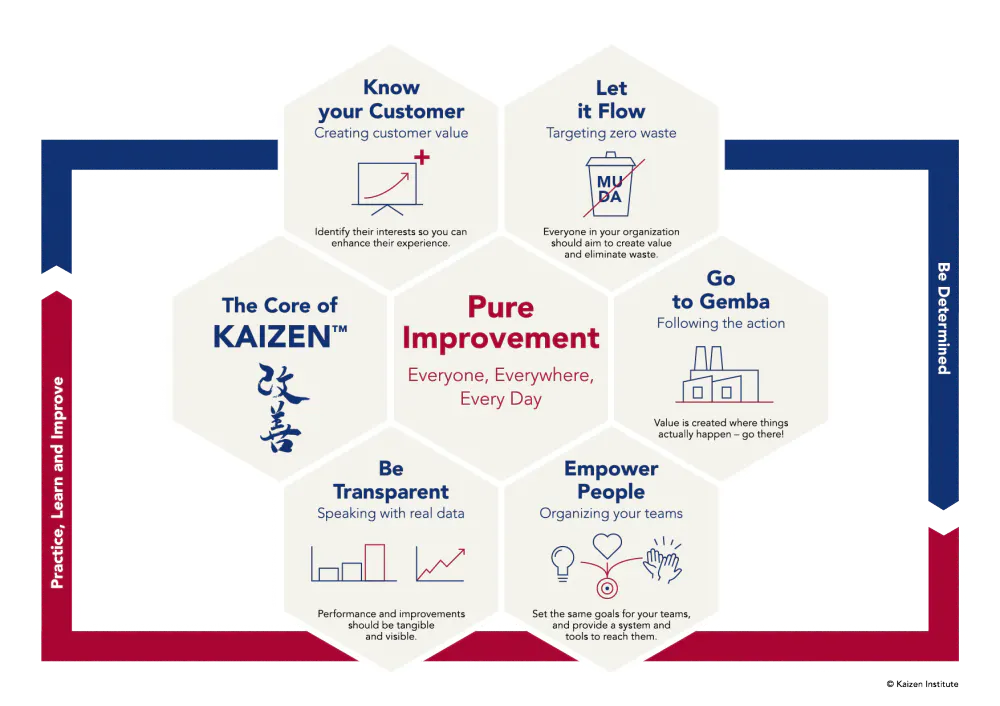
- Continuous improvement. No process is ever final; there is always room to improve its efficiency or effectiveness.
- Respect for people. Everyone, regardless of role, contributes to improvement.
- Standardization. Clear, repeatable processes make it easier to identify and refine areas for improvement.
- Elimination of waste (Japanese: “muda”). Any effort or resource that doesn’t add value should be reduced or removed.
- Gemba focus. Real insight comes from observing work directly where it happens, not from assumptions or reports.
By the 1980s, Kaizen had spread far beyond manufacturing. Its adaptability made it relevant to any organization striving for consistent progress.
As industries embraced digital transformation, Kaizen’s core principles remained the same, but their application evolved. The same focus on iteration, feedback, and learning that once powered factory floors now guides software teams as they manage complexity and rapid change.
Today, this mindset continues to deliver measurable results in data-driven environments. Recent studies show that companies applying structured, AI-supported improvement frameworks achieve up to 30 % faster decision-making and twice the productivity, while high-performing software teams maintain daily deployments and change-failure rates below 1 %.
Why Kaizen Works in Software Development
As the global economy shifted toward digital transformation, many technology companies began facing challenges similar to those of Japan’s postwar manufacturers: tight deadlines, complex systems, and the need for consistent quality at scale.
Modern software development is built on iteration: code is written, tested, deployed, and improved continuously. The pace of technological change demands adaptability without chaos, structure without rigidity.
That’s why many teams turn to the Kaizen philosophy. Instead of waiting for big, dramatic changes, they make small improvements every day. A practical, incremental approach keeps quality high, feedback loops short, and teams focused on measurable progress, one iteration at a time.
This practical, incremental approach keeps quality high, feedback loops short, and teams focused on measurable progress, one iteration at a time.
Kaizen provides a disciplined yet flexible way to achieve that balance. Its cycle of improvement follows five essential steps:
- Identify problems. Observe workflows to detect inefficiencies, bottlenecks, or recurring issues.
- Analyze causes. Use data, retrospectives, and feedback to understand the root cause rather than treating symptoms.
- Develop solutions. Brainstorm improvements collaboratively and select those that are simple, measurable, and low-risk.
- Implement changes. Apply improvements immediately and test their impact in real conditions.
- Review and standardize. If the change works, document it and make it part of the standard process. If not, adjust and repeat.
For IT teams, that mindset means fewer surprises, faster releases, and more predictable outcomes. It aligns perfectly with Agile and CI/CD development approaches, turning continuous delivery into continuous learning. A developer, designer, or QA engineer can propose an improvement, validate it, and see it adopted company-wide.
According to Atlassian, teams that apply structured iterative improvement achieve up to 50% faster incident recovery times and 40% lower defect rates, a tangible reflection of Kaizen in digital practice.
At Unique Technologies, these ideas are established practice, shaping the company’s daily operations.
Unique Technologies’ Experience: Lessons From Practice
Unique Technologies has applied Kaizen principles since its early years. One of the most formative experiences came through collaboration with Fujitsu, where the team adopted a month-long release cycle that included structured reflection before each delivery. Developers and managers reviewed the previous release, identified what caused delays or rework, and applied lessons immediately.
This process became our Kaizen challenge: a recurring cycle of evaluation, adaptation, and execution. It demonstrated that small, consistent efforts can have a compounding effect on quality and efficiency.
Today, the company applies the same approach in projects across Japan, Central Asia, and other countries. Whether working on data automation, AI tools, or enterprise systems, teams use measurable metrics, such as cycle time, defect rate, and deployment frequency, to track progress and identify areas where improvements are needed.
Each project is not just a delivery, but also a laboratory for learning and refinement, where teams test ideas, measure outcomes, and turn insights into better practices. This constant experimentation forms the backbone of the company’s Kaizen process.
The Kaizen Process: Coding, Teamwork, and Improvement
Kaizen at Unique Technologies lives inside the workflow, not outside of it, in every part of the development process:
- In coding. Developers treat every commit as an opportunity to make the product cleaner, faster, and easier to maintain. Regular refactoring keeps the codebase healthy and sustainable.
- In teamwork. After each sprint, teams hold retrospectives to reflect on what worked and what didn’t. The goal is not to assign blame but to find simple ways to make collaboration smoother.
- In process improvement. Project managers and team leads review workflows and metrics, looking for friction points that can be removed with better automation, clearer documentation, or smarter communication.
This rhythm of reflection and action keeps the organization in a state of steady progress. Each improvement fuels the next, and that cycle never stops.
This culture of steady refinement doesn’t stop within the team. As every process becomes more transparent and predictable, the benefits naturally extend to clients.
How Kaizen Strengthens Teamwork and Client Collaboration
For project managers and business leaders, collaboration with an outsourced team often comes down to one question: can the process stay predictable while still adapting to change? Kaizen provides the structure for that balance and makes improvement a shared responsibility.
At Unique Technologies, the Kaizen mindset shapes how teams communicate and make decisions. Every sprint closes with a short reflection, not only to discuss deliverables, but to ask what slowed the team down and what made it faster. Developers and managers record these insights as “Kaizen tasks,” which are revisited at the next sprint.
What makes this approach different is transparency. Clients are part of this feedback loop. They see not only the outcomes, but also the reasoning and data behind every improvement. Over time, this builds confidence: teams become more proactive, and clients gain visibility into how their product and process evolve together.
In long-term partnerships, this rhythm of reflection reduces misalignment and helps both sides anticipate change before it becomes a risk. For distributed projects, where distance and time zones often blur communication, Kaizen provides a common language: small steps, measurable outcomes, continuous alignment.
By focusing on open metrics, regular reflection, and shared accountability, Kaizen transforms collaboration from contract-based management into a genuine partnership.
The same principles that strengthen teamwork also make organizations more adaptable. Let’s elaborate on that.
Kaizen for Resilience: Building Adaptive Companies
Resilience in tech turns every disruption into an opportunity to accelerate. Kaizen provides the structure for that: a way to adapt fast, make evidence-based decisions, and sustain performance even when the environment shifts.
For Unique Technologies, resilience means staying responsive without losing stability. When markets, tools, or client expectations evolve, the team doesn’t rebuild processes from scratch. Instead, they apply the same Kaizen logic: test small, measure impact, and scale what works.
During a project for a Japanese luxury retail brand, the system was initially designed to respond within five seconds. Yet user testing revealed that boutique staff perceived anything slower than two seconds as “lag.” Within just three weeks, the team re-optimized the platform to achieve consistent sub-one-second responses across all devices, not because of a major overhaul, but through precise, iterative refinements.
That’s what resilience looks like in action: the ability to listen, learn, and adapt without derailing progress.
Conclusion
Kaizen, the Japanese principle of “change for the better,” perfectly captures how Unique Technologies approaches both software and teamwork. Continuous improvement in coding, communication, and leadership keeps the company evolving, project after project.
Kaizen is not just a management idea. It’s a way of thinking that makes every iteration, every release, and every collaboration a little better than before.
In the end, progress is not about perfection. It’s about getting better together, one step at a time.
Build software that gets better with every iteration. We’ll show you how Kaizen principles translate into measurable results for your projects. Contact us now.